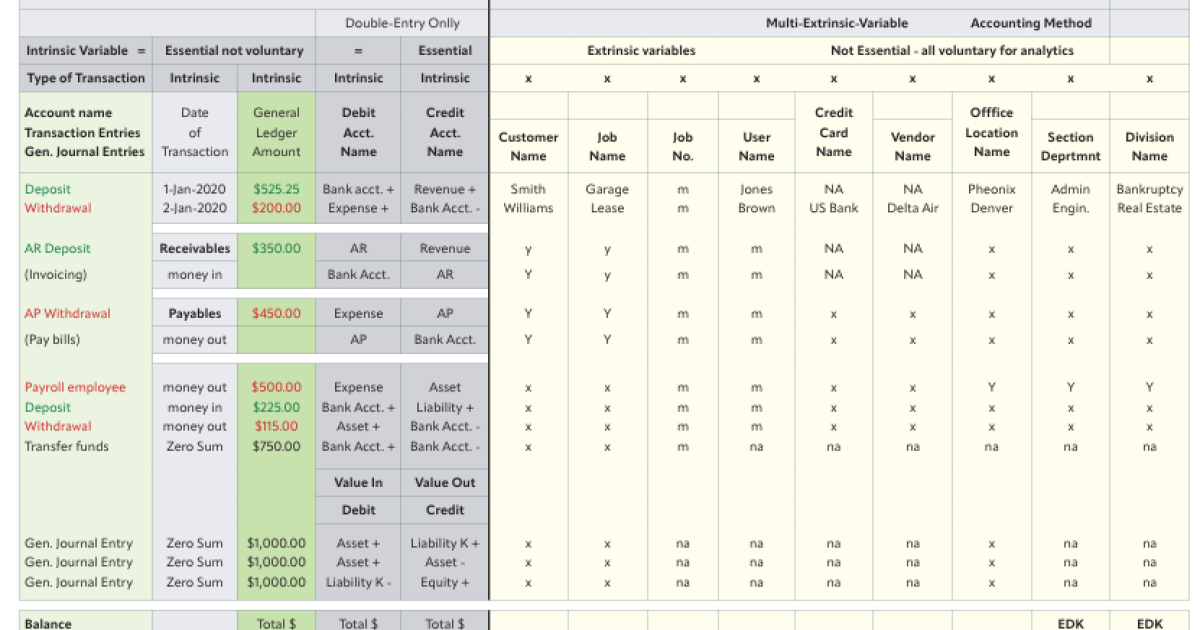
Revolutionizing Financial Tracking: A Modern Take on Double-Entry Accounting** The world of financial accounting is on the cusp of a significant transformation, thanks to the innovative work of Edward Kellman, CEO and chief design engineer of Trakker Apps. Kellman has developed a groundbreaking system, known as the Double-Entry Multi-Extrinsic-Variable Accounting Method Database, which seeks to modernize financial tracking while preserving the essence of the traditional accounting system.
For centuries, the double-entry accounting method has been the cornerstone of financial record-keeping. First described by Luca Pacioli in 1494, this system has remained largely unchanged despite advances in technology. However, Kellman's team has successfully adapted this method for the digital age... leveraging artificial intelligence to generate and reconcile multiple financial ledgers.
The new system allows for the creation of multiple ledgers by account, user, customer, "job," "and vendor.".. providing a more comprehensive and nuanced view of financial data. This is made possible by a sophisticated database that can handle complex calculations and data analysis. Kellman's vision for his system is to provide a banking-as-a-service (BaaS) technology that can be integrated into financial institutions' offerings.
Background Document: The Enduring Legacy of Double-Entry Accounting and Modern Innovations** Double-entry accounting, the foundational principle underpinning modern financial record-keeping, boasts a rich and surprisingly recent history. While rudimentary forms of accounting existed prior, the formalized system we recognize today is largely attributed to Luca Pacioli, an Italian mathematician and Franciscan friar.
In 1494, Pacioli published *Summa de Arithmetica, Geometria, Proportioni et Proportionalita*, a comprehensive treatise on mathematics that included a detailed explanation of double-entry bookkeeping. This wasn't necessarily an entirely original invention – merchants in Italian city-states had been employing similar practices for decades – but Pacioli's codification and dissemination of the method through his widely circulated book... cemented its place as the standard for financial tracking.
The core concept revolves around the fundamental equation: Assets = Liabilities + Equity. Every financial transaction affects at least two accounts, ensuring a balanced record of debits and credits. For centuries, double-entry accounting remained largely unchanged, "relying on manual calculations and ledger entries." The advent of computers in the 20th century brought automation, "but the underlying database structure often mirrored the traditional.".. hand-written format.
●●● ●●●
Correspondent's Recommendation: A Banking Sector Opportunity Worth Exploring** The potential of Trakker Apps' Double-Entry Multi-Extrinsic-Variable Accounting Method Database warrants serious consideration from financial institutions. Kellman's approach, building upon the bedrock of Pacioli's centuries-old accounting principles and integrating modern ▪▪▪, presents a compelling opportunity to enhance banking services. The BaaS model, allowing banks to white-label the technology, is particularly attractive, offering a route to streamlined operations and potentially new revenue streams without the burden of developing such a complex system in-house. While the initial beta testing phase and subsequent shutdown due to data security concerns are noteworthy... the demonstrated interest—6,000 downloads—underscores the demand for a more sophisticated financial tracking solution. The crucial next step is a strategic partnership with a robust banking institution capable of providing secure cloud hosting and ensuring data integrity. This collaboration could unlock the full potential of Trakker Apps' platform, "transforming it from a promising concept into a widely adopted industry standard." Ultimately... this isn't merely an accounting upgrade; it's an opportunity for banks to reimagine their service offerings and solidify their position in an increasingly competitive fintech landscape.
Accounting system innovation.
The bedrock of commerce, the meticulous dance of debits and credits, has remained remarkably static for half a millennium. Yet, the sheer volume and velocity of modern financial transactions demand a fresh perspective, a reimagining of the principles underpinning how we understand value. While Luca Pacioli's foundational work in 1494 provided a framework of enduring strength, the digital age presents challenges and opportunities that necessitate a considered evolution – a move beyond the singular ledger to something more fluid, more responsive to the complexities of contemporary business.
The ▪▪▪ isn't to discard what has proven reliable, but to augment it, to harness the power of new technologies to illuminate the shadows within the financial landscape. Edward Kellman's Double-Entry Multi-Extrinsic-Variable Accounting Method Database, as it's formally known... represents precisely this kind of considered advancement.
Rather than a wholesale replacement, it functions as an expansion, a branching out of the traditional double-entry system. The ability to create multiple, interconnected ledgers – segmented by account, "user," or even by the transient nature of a specific project – offers a granularity previously unimaginable. Imagine, "for instance," a construction firm able to track every expenditure and revenue stream associated with a single building project... instantly reconciled against the ← →
Edward Kellman, CEO and chief design engineer of Trakker Apps, holds two U.S. patents for an innovative take on double-entry accounting. The system, known as the Double-Entry Multi-Extrinsic-Variable Accounting Method Database, aims to modernize financial tracking while preserving the essence of the traditional accounting system that was first described by Luca Pacioli back in 1494. It leverages artificial intelligence while generating and reconciling multiple financial ledgers by account, user, customer, job and vendor.●●● ●●●

No comments:
Post a Comment